
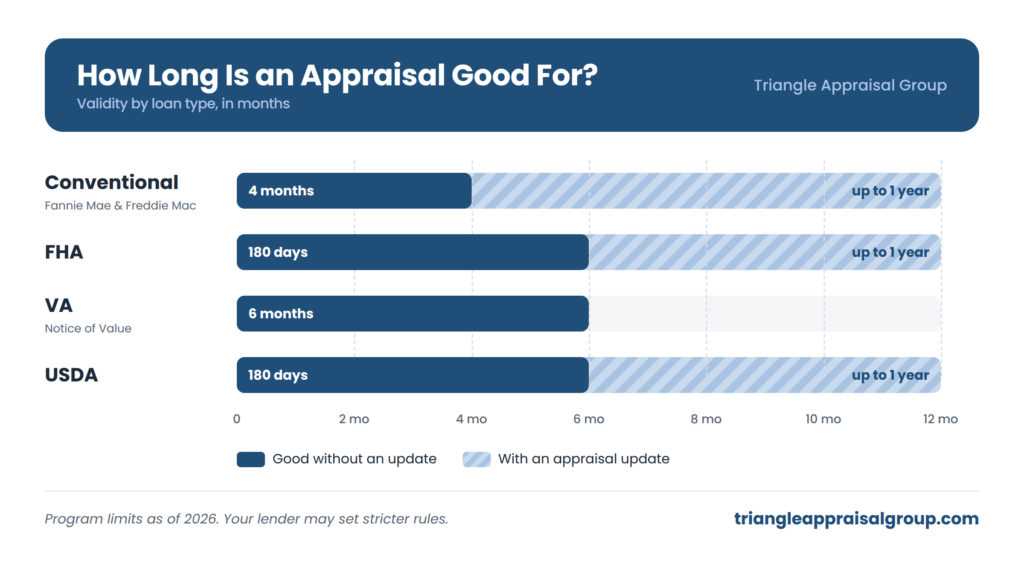
Most home appraisals are good for about 4 to 6 months, and many can be extended to a full year with an appraisal update. The exact timeline depends on your loan type. Conventional appraisals need an update after 4 months. FHA, VA, and USDA appraisals are good for about 6 months.
An appraisal sets your home’s value at a specific moment in time, but that value doesn’t last forever. Below, we’ll break down the rules for each loan type, what can shorten an appraisal’s life, and what to do if yours expires.
How Long Is an Appraisal Good For? (By Loan Type)
Loan Type
How long it’s good for
Can it be extended?
Conventional (Fannie Mae & Freddie Mac)
4 months (120 days) before closing
Yes. An appraisal update can extend it by up to 12 months
FHA
180 days
Yes. An update can extend it by up to 1 year
VA
6 months
Ask your lender
USDA
180 days
Yes. One update, up to 1 year
Private appraisals (divorce, estate, tax appeal, pre-listing)
No set expiration. For pricing or planning, many people update after 3–4 months.
Depends on why you need it (see below)
These are the program limits. Your lender can set stricter rules.
What Affects How Long an Appraisal Stays Useful?
Even inside those limits, several things can make an appraisal outdated sooner:
- Market conditions: In a steady market, a value holds up well. When prices, demand, or interest rates shift quickly, an appraisal can go stale fast.
- Lender policies: Each lender can set its own, stricter rules, especially for riskier loans.
- Changes to the property: A big renovation, storm damage, or a new addition can change the value, so the old appraisal no longer tells the full story.
- Refinancing or borrowing against your home: Lenders need a current value to set your loan terms, so an older appraisal usually won’t work.

TAG Tip: Housing markets don’t stay steady for long. During the COVID-19 surge, homes often sold well above asking price, making even recent appraisals feel outdated. During the 2008 housing crisis, the opposite was true: appraisals quickly lost accuracy as home values dropped. That’s why a fresh, local perspective matters more than a date stamp.
Do Private Appraisals Expire?
Not in the same way. Every appraisal gives a value as of one specific date, called the effective date. For appraisals that aren’t tied to a loan, that date matters more than how old the report is:
- Divorce appraisals usually need a value close to the date of separation or settlement. Learn more about our divorce appraisals.
- Estate appraisals often look back to the date someone passed away. See Date of Death Appraisals in North and South Carolina.
- Property tax appeals in North Carolina look at value as of January 1 of your county’s last reappraisal year, not today’s value. Learn about our property tax appeal appraisals.
What To Do When Your Appraisal Expires
If your appraisal has expired, don’t worry, you still have options:
- Appraisal update: The original appraiser reviews the market since the first appraisal and confirms whether the value has dropped. For conventional loans, this is done on Fannie Mae’s Form 1004D. You may also hear it called a “recertification of value.”
- New appraisal: If the appraisal is more than 12 months old, the property has changed, or the market has moved a lot, you’ll need a brand-new appraisal.
Our appraisers handle conventional, FHA, and USDA loans, as well as private appraisals for divorce, estates, and tax appeals.
TAG Tip: If your closing might get pushed back, ask your lender early whether an update will be needed. An update is usually faster than starting over, and it keeps your timeline on track. Ready to refinance? Learn about our refinance appraisals.
FAQs
Do home appraisals expire?
Yes, for loans. Most are good for about 4 to 6 months, and many can be extended to a year with an update. Private appraisals don’t expire the same way, since they value a home as of a specific date.
How long is an appraisal good for when refinancing?
The same loan rules apply. For a conventional refinance, the appraisal needs an update after 4 months. For FHA, it’s good for 180 days.
Can a new buyer use the seller's old appraisal?
Usually not. An appraisal belongs to the lender who ordered it, so a new buyer’s lender will typically order its own. FHA appraisals are tied to the property’s FHA case number and can sometimes carry over, so ask your lender.
What's the difference between an appraisal update and a new appraisal?
An update confirms that the original value still holds, using current market data. A new appraisal starts from scratch with a fresh inspection and a new value.
How long is a pre-listing appraisal good for?
There’s no official limit, but it’s most useful when your listing date is close to the appraisal date. If the market shifts before you list, an update can keep your price on target. Learn about our pre-listing appraisals.
Need a fresh appraisal in North Carolina? Contact the TAG team. Our reports are finalized 3–5 business days after inspection, so your timeline stays on track.

Connect with Rachel Mann on LinkedIn:
Thanks for reading! We love sharing insights from the TAG team, and we’re always looking to connect with others who are passionate about real estate, marketing, and community.
Have thoughts to share or want to collaborate on a future post? Let’s talk!