
Charlotte, North Carolina, can be a misunderstood market for investors. Especially those without hyper-local knowledge.
Although it’s one city, Charlotte is made up of multiple submarkets within the greater metro area, often just one mile apart, that can drastically affect a property’s value.
For investors, understanding these micro-market differences is critical to protecting margin and identifying opportunity.
We recently sat down with one of Charlotte’s own, Erik Eicheinger from I Fund Cities, to talk through what’s really happening in the Charlotte investor market, from growth pockets to shifting strategies and emerging risks.
Let’s break it down.
Investors Are Moving Beyond Charlotte Proper
One trend we discussed with Erik is the increasing migration of investors outside of Charlotte proper. And there is a good reason for it.
As Erik describes:
“If you just draw like an hour circle around Charlotte… those tertiary markets… Gastonia to Statesville, Salisbury, Kannapolis, Mint Hill, Rock Hill… their proximity to Charlotte just makes too much sense for those not to increase in value.”

This aligns with Charlotte’s population growth since 2019. As the city expands, surrounding markets that were once considered secondary are seeing increased demand.
Some investors are approaching these areas with a long-term appreciation mindset, while others are moving outward for ARV (as-repaired value) margins.
As Erik noted:
“We’ve seen some investors get out of Charlotte proper… to capture larger margins.”
Markets Charlotte Investors Are Watching:
- Gastonia, NC
- Statesville, NC
- Salisbury, NC
- Kannapolis, NC
- Mint Hill, NC
- Rock Hill, SC
Without local insight, newer investors may assume inner Charlotte is the primary opportunity. In reality, performance varies based on strategy, timing, and entry price. And in many cases, surrounding markets are producing stronger ROI.
Hyper-Local Knowledge Is the Competitive Advantage
Even within Charlotte’s city limits, pricing shifts dramatically.
Neighborhoods just a mile apart can have different buyer pools, renovation standards, pricing ceilings, and absorption rates.
For out-of-state investors, especially, this can introduce risk.
As Erik shared:
“It’s tough for investors outside of Charlotte who just look at Google maps and addresses to really understand what’s going on here.”
Surface-level data, automated valuation tools, and broad-radius comp searches often miss neighborhood-level trends. A property that appears strong on paper can lose margin quickly if it’s analyzed against the wrong pocket of the city.
Spotlight Contrast: Same City, Different Strategies
To understand how dramatic the differences can be, look at just two areas within minutes of each other.
Camp North End Area
Once considered a rougher part of town, this area has rapidly transformed into a redevelopment hotspot.
“Call it like where Camp North End is… that area used to be known as like a rougher side of town… and now investors are stepping over each other to try to get deals in this area.”
This is a growth pocket with high investor activity, shifting comps, and pricing that can move quickly as redevelopment continues.
Myers Park & South Charlotte
Now compare that to established luxury neighborhoods.
“You’ve got… super stable markets… like a Myers Park or a South Charlotte… more spec luxury… and they’re probably 10 to 15 minutes away from each other.”
These are mature, stable markets with higher price points, different buyer expectations, and tighter underwriting requirements.
Same city. Different risk profiles. Very different strategies.
The Strategic Shift from Fix-and-Flip to New Construction
In 2026, one of the more noticeable trends is the pivot from traditional fix-and-flip projects toward new construction.
At first glance, this seems surprising. But the reasoning is straightforward.
Flip margins are tightening, and seller expectations remain firm.
“Sellers… seem to be a domino that hasn’t fallen yet in terms of asking prices… people know what they have in Charlotte.”
That dynamic pushes acquisition costs higher.
“You’ve got to overbid to get a fix and flip deal done… so people have pivoted to new construction.”
Rather than absorbing unpredictable renovation costs, many investors are taking properties down to the studs or tearing them down entirely and rebuilding.
Why? Because new construction offers clearer cost modeling and fewer unknown variables compared to heavy rehabs.
The UDO + The "Duet" Effect
Charlotte’s Unified Development Ordinance (UDO) has significantly influenced investor strategy.
As Erik explained:
“There was a UDO… and… you could take the existing lot… and build what most people would drive by and say that’s a duplex… but in Charlotte they were calling ‘duets’ where you could actually sell each side individually.”
Instead of renovating a single home, investors realized they could tear it down and build two sellable units on the same lot.
This zoning change accelerated teardown activity.
“Rather than… renovate and sell… they were actually tearing it down knowing that they could get two units out of it.”
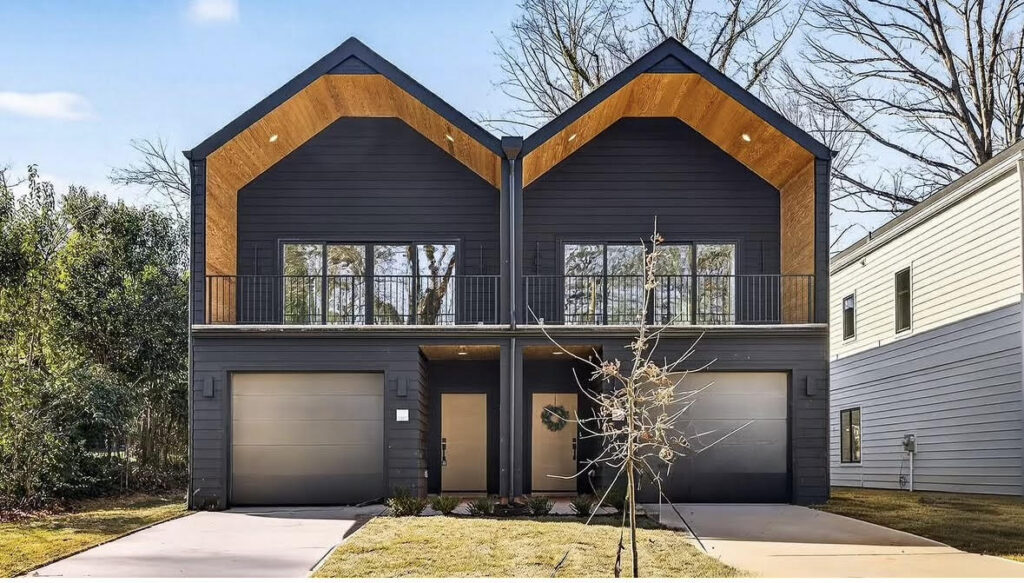
Charlotte’s growth continues, and investor participation strategies are evolving in response. Duets have expanded revenue potential in many areas and reshaped certain neighborhoods.
But, here’s the part we can’t ignore: when everyone moves toward the same strategy, certain segments can become oversaturated.
If too many duets hit the same price point, in the same pockets, at the same time, absorption slows. Margins tighten and competition increases.
The model itself isn’t the risk; crowding is.
The investors who navigate this well won’t just follow the zoning shift. They’ll stay strategic about location, timing, and buyer demand. Because in this next phase of Charlotte’s growth, success won’t necessarily come from building more.
It’ll come from building with intention.
TAG Tip: In a recent blog article, we sat down with Ian Lipman with BETTER Properties, who specializes in infill building in Durham, very similar to the duet story we are seeing in Charlotte. You can read more here.
The Hidden Variable: Comp Selection and Accurate ARVs
In a market this segmented, this competitive, and this dense with new product types, comp selection carries weight.
And when neighborhoods shift block by block, and product types shift from single-family to duets to townhomes within the same half-mile, valuation becomes layered. Fast.
A comp that looks close on a map can represent an entirely different buyer pool.
As Erik put it:
“You guys (Triangle Appraisal Group) do an incredible job on the appraisal side because you could have comps like a mile away that are in completely different neighborhoods, and it makes it challenging.”
And that’s exactly the issue.
In Charlotte’s current environment:
- Surface-level comparisons don’t hold up.
- You can’t treat a duet like a traditional duplex.
- You can’t assume a teardown rebuild competes with a 1990s infill renovation.
- You can’t stretch a comp just because it’s geographically convenient.
What investors actually need right now:
- Accurate as-is values before capital is deployed
- Reliable ARV projections based on true competitive properties
- Clear rental analysis when flip margins tighten
Because as supply increases and buyer expectations shift, small valuation gaps can materially affect margins.
TAG Tip: Triangle Appraisal Group specializes in ARV Appraisals for investors across North and South Carolina, including Charlotte. Contact us if you want to solidify margins on your next deal before deploying capital.
Final Takeaways for Charlotte Investors
Charlotte remains one of North Carolina’s most active and evolving investor markets.
Growth has not slowed, but the type of product entering the market has changed. Density is increasing. Micro-markets are diverging. Strategy matters more than speed.
The investors who continue to perform well are:
- Focused on neighborhood-level analysis
- Adjusting strategy as product types evolve
- Running disciplined underwriting before committing capital
Hyper-local awareness and disciplined analysis remain central to long-term performance in the Charlotte market.
Happy investing!

Connect with Rachel Mann on LinkedIn:
Thanks for reading! We love sharing insights from the TAG team, and we’re always looking to connect with others who are passionate about real estate, marketing, and community.
Have thoughts to share or want to collaborate on a future post? Let’s talk!