A divorce settlement appraisal gives you a neutral, professional value for your home, so it can be divided fairly. In North Carolina, the home is usually valued as of the date you separated, which often means the appraisal looks back to a past date.
Dividing property in a divorce is both emotionally and financially hard. Whether you’re buying out your spouse, selling, or splitting assets, a certified appraisal gives everyone one number they can trust. Let’s break it down.
How Home Values Are Divided in a North Carolina Divorce
North Carolina divides property through equitable distribution. The law presumes an equal split of marital property unless the court decides an equal split isn’t fair.
For your home, timing matters most:
- Marital property (property you acquired during the marriage, before separation) is valued as of the date of separation.
- Divisible property, such as a rise or drop in the home’s value after you separated, is valued as of the date of distribution, closer to when the property is actually divided.

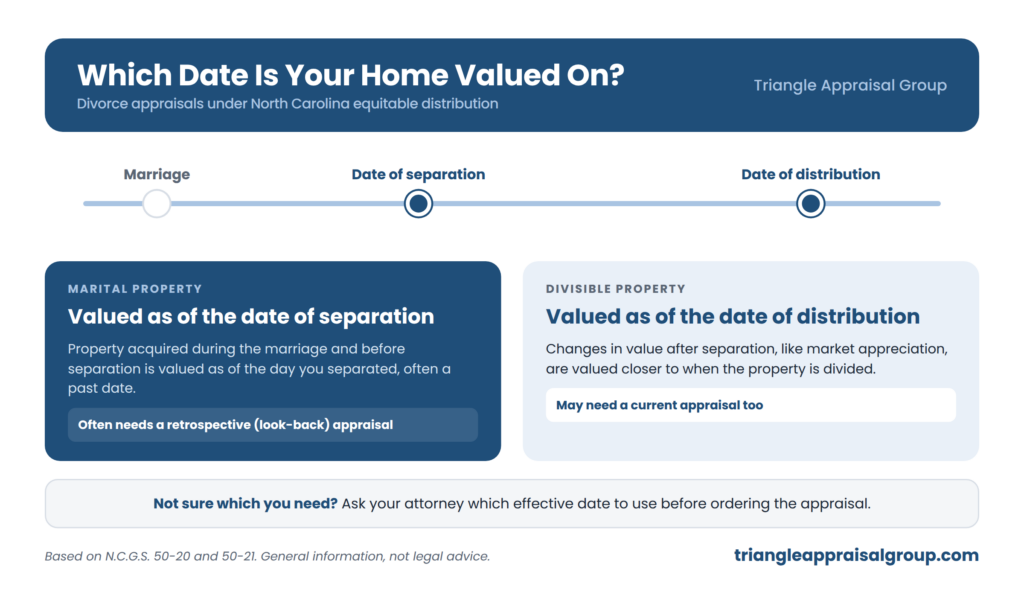
That’s why many divorce appraisals are retrospective: they tell you what your home was worth on a specific past date. Some cases also need a current value to account for changes since separation. Learn more in What Is a Retro Appraisal?
TAG Tip: Before you order an appraisal, ask your attorney which date (or dates) the appraisal needs to use. Getting the effective date right the first time saves time and money.
When You Need a Divorce Settlement Appraisal
Not every divorce requires a formal appraisal, but it becomes essential when:
- One spouse is buying out the other: A certified appraisal helps make sure the buyout reflects true market value.
- The case is going to court: A judge will need well-supported evidence of the home’s value.
- You’re in mediation: A neutral, third-party value gives both sides a fair starting point.
- The value is in dispute: Two competing opinions rarely settle anything. One independent appraisal often does.
What to Expect During a Divorce Appraisal
Once the appraisal is scheduled, a certified appraiser visits the home to review its condition, note any upgrades, look at the location, and analyze recent sales. For a retrospective appraisal, we also look at sales and market conditions around your date of separation.
With TAG, your report is finalized 3–5 business days after the inspection. To prepare, make sure the appraiser can get to all areas of the home. See The Home Appraisal Checklist You’ll Actually Want to Follow.
TAG Tip: If you’re simply selling the home and splitting the proceeds, a real estate agent’s market analysis may be enough. But when there’s a buyout, a dispute, or a court case, attorneys and courts generally expect a certified appraisal from a licensed appraiser.
Divorce Appraisals Across North Carolina
Our team handles divorce appraisals across North Carolina and into South Carolina, including Charlotte, Raleigh, Durham, Winston-Salem, Wilmington, and Myrtle Beach.
The TAG Advantage in Divorce Appraisals
Our clear, well-supported reports help reduce conflict throughout divorce proceedings. Here’s what sets TAG apart:
- Local analysis: We value your home using recent local sales, upgrades, and neighborhood trends.
- Retrospective and court-ready reports: We provide values as of specific dates, like your date of separation, following USPAP, the national standards for appraisers.
- Neutral and unbiased: Our reports are transparent and objective, designed to reduce disputes before they start.
- Fast turnaround: Reports are finalized 3–5 business days after inspection, so your case doesn’t stall.
- Trusted by attorneys: We work with attorneys throughout North and South Carolina for mediation and trial.
Why It Matters
Your home is likely your largest financial asset, and a clear, well-supported value matters for everyone involved:
- Homeowners: Peace of mind that your home’s value is fair, accurate, and unbiased.
- Attorneys: Appraisals that hold up in mediation or court, so you can advocate for your client with confidence.
- Lenders: Buyout and refinance loans backed by an accurate market value.
Wondering who keeps the home? Read In a Divorce, Who Gets the House?
FAQs
What date is my home valued on in a North Carolina divorce?
Marital property is generally valued as of the date of separation. Changes in value after separation (divisible property) are valued as of the date of distribution. Your attorney can confirm which dates your case needs.
Can an appraisal be done for a past date?
Yes. A retrospective appraisal values your home as of a specific past date, like your date of separation, using sales and market conditions from that time.
Do both spouses need their own appraisal?
Not necessarily. Many couples agree on one neutral appraisal to avoid competing numbers. In contested cases, each side may hire its own appraiser.
Is a Zestimate or tax value good enough for a divorce?
Usually not. Online estimates and tax values aren’t based on an inspection and won’t hold up well in mediation or court. A certified appraisal is the stronger choice.
How long does a divorce appraisal take?
TAG finalizes reports 3–5 business days after the inspection. Retrospective appraisals follow the same timeline.
This article is for general information only and isn’t legal advice. Talk with a family law attorney about your specific situation.
Need a neutral value for your home? Learn about our divorce appraisals or contact the TAG team. TAG us in!

Connect with Rachel Mann on LinkedIn:
Thanks for reading! We love sharing insights from the TAG team, and we’re always looking to connect with others who are passionate about real estate, marketing, and community.
Have thoughts to share or want to collaborate on a future post? Let’s talk!